Aeroclub Friulano · Our history
A history of flight since 1913
From the first landings to the founding of the club: six chapters trace the passion for flying that shaped Campoformido.


1913–1918
The beginnings of aviation
On 31 July 1913, Gino Zanuso lands on the meadows of San Canciano. During the Great War, Campoformido hosts flying units and leading Italian aviators, including Francesco Baracca and Gabriele d’Annunzio.
Read the chapter: The beginnings of aviation
For aviation enthusiasts, the name Campoformido inevitably evokes the beginnings and achievements of Italian aviation in what were perhaps its most remarkable and exciting years.
Campoformido had until then been known for the historic treaty that ended Napoleon’s Italian campaign and the Republic of Venice. Its aviation story begins at 06.45 on 31 July 1913, when the Bleriot flown by Captain Gino Zanuso lands on the meadows of San Canciano. Waiting for the pilot from the Aviators’ Battalion are an Alpini officer and several mechanics, who mark the landing area with bedsheets.
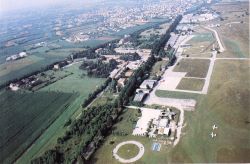
The meadows of San Canciano take their name from the saint to whom the small country church there is dedicated. Immediately south of the road linking Campoformido and Udine, and crossed by the Vecchia Postale road, they are particularly well suited to aviation.
It is the beginning of a “wonderful adventure”.
On 5 May 1915, shortly before the outbreak of the “Great War”, the first flying units arrive. These are the Bleriot monoplanes of the 5th, 6th, 7th and 8th Squadrons. The first three settle between the railway and the main road, while the last operates near the village of Santa Caterina. The Bleriots of the 5th and 6th Squadrons see action on the day after the conflict begins, bombing strategic targets at Monfalcone.
Other units arrive with increasingly capable aircraft. Among them are the Nieuport Ni.10s that will form the first fighter units, and Lieutenant Francesco Baracca is one of the pioneers of this new role.
Baracca, serving with the 8th Nieuport Squadron, is tasked, together with his squadron colleagues and those of the 2nd Farman Squadron, with defending Udine, the seat of the Supreme Command.
The ranks on Campoformido’s meadows grow as more units and aircraft arrive. Friuli now becomes the cradle of Italian aviation, and Campoformido’s network of airfields is the largest in the region. While Italian fighter pilots pursue the victory they have long dreamed of, Gabriele d’Annunzio flies in the Farmans of the 9th Squadron. With Captain Beltramo, he dreams of a demonstration flight over enemy territory: the idea of the flight over Vienna is born at Campoformido. In his “Notturno”, the poet describes, in his own distinctive way, the sensations of flying above the battlefields:
“I have never felt so full of music as in the pauses in battle … I think back to the return from the air raid on Canale, with Ermanno Beltramo; the passage through the skies of Gorizia, beneath domes of two-coloured explosions; the involuntary descent from three thousand metres to twelve hundred, as exhilarating as the climb; the shared mocking gesture towards the enemy who failed to correct his aim; the disregard for the pain in my half-frozen right hand; the musical surge against the engine’s fading note; the wild urge to sing. Lyrical ignition, cold radiators … I said, leaping from the cockpit onto the grass of Campoformido. And I was hungry…” Victory smiles on Italian wings. On 7 April 1916, Baracca shoots down his first enemy aircraft as it returns from bombing Casarsa railway station. The damaged Brandemburg C1 (61.57) lands near Medeuzza. The small reconnaissance aircraft and tiny fighters are joined by the huge Caproni Ca.3 bombers, carrying their deadly loads beyond the lines under escort from Italian fighters.
Italy’s finest fighter pilots are brought together in a new unit, the 91st Squadron, later known as the “Squadron of Aces”. Alongside Baracca, Olivari, Ranza, Ruffo di Calabria, Tacchini, Gorini, Sabelli and Costantini fly and win renown.
Then come the dark days of late October 1917, when enemy divisions break through the front in the Plezzo basin. The flying units must also withdraw, but continue fighting until the enemy reaches the outskirts of Udine. Campoformido’s airfields are abandoned, the barracks burned and unserviceable aircraft destroyed.
After the bloody Battle of the Piave, the enemy is defeated and driven back. The “terrible year” of Austro-Hungarian occupation finally ends. Italian troops recapture Udine, and on 4 November 1918 the last enemy infantrymen leave the town and Campoformido airfield.
The Italian tricolour once again flies over the meadows of San Canciano.
1923–1936
Aerobatics and the founding of the club
With the 1st Wing, Campoformido becomes a centre for formation aerobatics. Aeroclub Friulano is founded on 25 September 1929, launching pilot training and, later, gliding courses.
Read the chapter: Aerobatics and the founding of the club
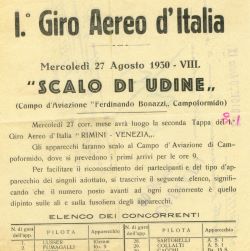
With the rise to power of Fascism and its leader Benito Mussolini, the organisation of the Armed Forces is transformed by the creation of a third, new service: the Regia Aeronautica, on 28 March 1923. A period of reorganisation and reconstruction begins. Old facilities are renovated, new ones built, and airfields named after decorated aviators who have fallen in service. On 7 May 1923, a formal ceremony names Campoformido after Major Ferdinando Bonazzi, a highly decorated Caproni bomber pilot. On 1 February 1927, the 1st Wing arrives from Lonate Pozzolo under Colonel Luigi Govi, equipped with the new Fiat CR.1 fighters. Its members are enthusiasts, young men who love flying and its risks. They begin performing increasingly daring aerobatics, eventually flying them in formation and inventing a new way of flying. They astonish the crowds by creating the first aerobatic team, which, after acquiring the new FIAT CR.20 fighter, takes part in the 1st Giornata dell’Ala at Rome’s Urbe airfield in 1930. The displays of the “Boys of Campoformido” keep thousands of spectators looking skywards, and their daring amazes enthusiasts and fellow pilots alike. Also in 1930, Campoformido’s aerobatic team undertakes its “Eastern Tour”. As the team wins well-deserved acclaim, Aeroclub Friulano quietly takes shape at Campoformido under Celso Ferrari.
Formally established on 25 September 1929, Udine’s flying club is named after Sergeant Giacomo D’Odorico, a Caproni pilot from Udine who died near Aquileia on 13 September 1916. Established from a section of the Aerocentro Milanese, Aeroclub Friulano begins its 1st flying course, called “dell’Oca Volante” (“the Flying Goose”), using an old Aviatik. Several FIAT AS.1s soon join it. Housed in the 1st Wing’s hangars, they allow the club to flourish and gradually become independent. Pilots and technical specialists from the 1st Fighter Wing form a new, distinguished unit, the 4th Fighter Wing, on 1 June 1931. Further pilots and specialists are drawn from the 1st Wing, now equipped with the legendary FIAT CR.32, to establish what will become another renowned fighter unit, the 6th Wing. Alongside the fighters bearing the “Archer” and “Grinning Devil” emblems, Aeroclub Friulano thrives under the presidency of Count Orti Manara and the passionate direction of instructor Raffaello Scarton. The Udine club now has a substantial fleet and has recently begun gliding courses. In the years to come, these will attract hundreds of student pilots from across Italy, making Campoformido one of the country’s leading flying clubs.
In 1936, the Royal Airfield at Campoformido is named after the Friulian pilot Lieutenant Luigi Gabelli, who has recently died in Ethiopia and been posthumously awarded a Gold Medal.
While the 1st Fighter Wing fights in the skies over Malta, the flying club continues training new pilots for Italy and its air force alongside the newly established Land-Based Fighter Training School. Many will don flying suits, sew distinguished emblems onto their chests and wear military stars on their collars, serving their country with honour and courage in a war against an overwhelmingly stronger enemy. Udine’s aviators nevertheless gather around the few who remain at the historic “Arizona degli Aviatori”, the bar and trattoria that has welcomed the best of Italian aviation, where Gigi Covre and his Mariute offer everyone warm hospitality.
1943–1947
The war years
Bombing in January 1944 severely damages the airfield. The Royal Air Force takes over in May 1945. In October 1947, Campoformido is returned to the Italian authorities and the Italian Air Force.
Read the chapter: The war years
In 1943, the war turns in favour of the Allies, and Italian forces are forced to retreat on all fronts. Powerful American bombers begin appearing above Italian cities, and the end draws near. On 8 September 1943, General Badoglio announces the armistice over EIAR radio. On the same day, Allied amphibious forces land at Salerno. Chaos reigns, and there are no orders. Colonel Reglieri, commander of Campoformido airfield, gathers everyone together: rather than issue orders, he urges them to “act according to conscience”.
The new republic in northern Italy establishes its Armed Forces, including the Republican Air Force. Pilots and technical specialists respond to the charismatic Lieutenant Colonel Botto’s call, swelling its ranks. The first fighter unit to be formed is the 1st Fighter Group, equipped with Macchi C.205s. Transferred from Lagnasco to Campoformido on 12 January 1944, it immediately begins an arduous operational campaign, mainly against the large Allied formations flying up the Adriatic towards the Reich’s industrial heartland. On 30 January 1944, Campoformido is hit by 3700 fragmentation bombs dropped by the powerful B-24 “Liberators” of the 449th and 450th Bomb Groups. American air forces attack again the next day. This time, the Boeing B-17Gs of the 2nd Bomb Group drop heavy 1000-pound high-explosive bombs. After this further attack, Campoformido airfield is devastated: all its facilities are severely damaged, the legendary “Arizona degli Aviatori” is gone, and the airfield of the “Pattuglia Folle” is lost forever. Having expanded considerably southwards, with a network of taxiways linking dozens of blast shelters, Campoformido then becomes a base for Luftwaffe units flying Bf109, Ju88 and Ju188 reconnaissance aircraft. The fast twin-jet Arado A234Bs join them in mid-March 1945.
These innovative aircraft take off from Campoformido and return with dozens of metres of exposed film showing the Allied ports of Brindisi, Ancona and Marseille, and other important strategic targets. Despite this deployment of technology, the fate of the Italian and German forces is sealed. On 1 May 1945, British troops enter Campoformido airfield, documenting captured equipment and destruction. The Royal Air Force takes possession, renames it “Udine R.A.F. Station” and bases Mediterranean Air Force units there, as at nearby airfields in Friuli and eastern Veneto. This powerful tactical air force is officially disbanded on 28 May 1945, when the British command celebrates “Victory Day” with a flypast of more than 700 aircraft over Campoformido. The British return Udine airfield to the Italian authorities and the Italian Air Force in the first week of October 1947, and Campoformido once again becomes “Luigi Gabelli” Airport.
1948–1950
A new beginning
On 28 April 1948, Bonzi and Lualdi set off on their non-stop flight to Massaua. Aeroclub Friulano resumes its activities in 1950, with new aircraft and pilot training courses.
Read the chapter: A new beginning
The airfield’s revival in the immediate post-war period is difficult, reflecting the state of the country as a whole. The Italian Air Force no longer bases flying units there, although it uses the airfield as a stopping point for its aircraft. Some of these, serving with the Military Air Couriers, support air links in an Italy whose transport network is still badly damaged. On the morning of 28 April 1948, Bonzi and Lualdi take off from Campoformido in their small SAI S.1001 “Grifo” for what will become Italian aviation’s first post-war sporting achievement: a record-breaking non-stop flight from Campoformido to Massaua. Aeroclub Friulano is revived in 1950, following the forced suspension of its activities after the events surrounding the 1943 armistice and the difficult acquisition of two aircraft. The Taylorcraft “Auster” I-TONE and AVIA FL.3 I-AVIM are the first aircraft in which Friuli’s sport pilots take to the air again. Around them gathers the first group of enthusiasts who will create one of Italy’s most active flying clubs. The first pilot training courses begin at Aeroclub Friulano. Alongside the new local pilots, guided by the expert advice of instructor Bruno Ganda, many Austrian enthusiasts earn their licences here, obliged to train in Italy by the stringent armistice terms imposed on Austria.
1954–1966
A new era
The first Army Pipers arrive in 1954, followed by helicopters in 1964. Meanwhile, the club prepares its major annual airshows, beginning with M.A.C. 1 in 1966.
Read the chapter: A new era
On 7 June 1954, the first Piper L.21Bs of the newly established Army Light Aviation land at Campoformido. The north-eastern part of the southern airfield begins to fill with prefabricated buildings and small dismantlable metal hangars. This young branch of the Army consists of small units known as Light Aircraft Sections.
In October 1958, after the long pierced-steel-planking runway has been dismantled, construction begins on facilities that, on 1 March the following year, will receive the high-speed guided interceptors supplied by the United States to the Italian Air Force and assigned to the 1st, 2nd, 3rd and 4th Squadrons. The powerful Nike “Ajax” and “Hercules” missiles deployed on the southern airfield bear the celebrated emblem of the 1st Guided Interceptor Air Brigade on their fins. The Italian Air Force has just acquired the G.91. In June 1959, the 103rd Group, responsible for its evaluation, deploys to Campoformido to test the jet’s suitability for grass airfields. Around the same time, the Air Force decides to assign its display duties to a single unit, rather than rotating them among different units. It chooses to return the aerobatic team to Friuli, where it originated in the 1930s. Thus, on 1 March 1961, the F-86Es of the Special Unit arrive at Rivolto. They form the nucleus of the remarkable unit that, on 1 July that year, will become the 313th Aerobatic Training Group “Frecce Tricolori”.
In 1964, the arrival of the Army units’ first helicopters breaks with the long fixed-wing tradition that has always defined the airfield. Meanwhile, Aeroclub Friulano begins preparing for its golden years, which will culminate in major annual airshows, starting with M.A.C. 1 (Manifestazione Aerea Campoformido, or Campoformido Airshow) in 1966.
1986–1998
A passion that endures
The Frecce Tricolori perform at Campoformido for the last time in 1986. After the last Army unit leaves in 1998, Aeroclub Friulano keeps the passion for flying alive.
Read the chapter: A passion that endures
As the years pass, economic difficulties gradually affect every organisation sharing Udine’s airport grounds. In 1986, the “Frecce Tricolori” perform above the historic airfield for the last time, ending a tradition that began when they were first based in Friuli. The Army decides that the last military flying unit operating from Campoformido, the 5th “Rigel”, must leave as part of a much-needed rationalisation of financial and operational resources. The last “blue berets” depart for Rimini-Miramare Airport in 1998. The historic Aeroclub Friulano remains the airfield’s sole user. Through changing fortunes and countless difficulties, it keeps the flame of enthusiasm alive, gathering at its historic clubhouse an ever smaller group of enthusiasts, many of whom are drawn to the numerous ultralight flying organisations that have developed in the region during the 1990s.
From “Campoformido 100” by R. Bassi – Aviani e Aviani Editori, 2013
Archive photographs